What Are Chicano Tattoos? Meanings and Classic Designs Featuring Clocks, Women, and More
2025/04/02
2026/04/02
2026/04/02



Chicano tattoos trace their roots to the western United States and are deeply connected to the culture and history of Chicano and Chicana communities, Mexican Americans living primarily in the U.S.
Chicano tattoos spread especially through urban areas such as Los Angeles, where they evolved as a powerful form of expression—depicting religious symbolism, love for family, and deeply personal life stories.

While influenced by prison culture and gang communities, the Chicano tattoo style developed a highly refined artistic identity, built on black and grey tattoo techniques and known for its realism and emotional depth.
Today, Chicano tattoos are embraced not only within the community but also by rappers, artists, and tattoo enthusiasts worldwide, making them one of the most respected and popular tattoo styles globally.
In this article, we’ll explore the history of Chicano tattoos, the differences between Chicano style and general black and grey tattoos, and introduce some of the most iconic Chicano tattoo designs.
Chicano is a term primarily used to refer to Mexican American men living in the United States, while women are often referred to as Chicana. The term became widely used as a way to emphasize identity and pride, especially in the context of the civil rights era and the Chicano Movement of the 1960s.
At the time, many Mexican American youths protested social inequality and discrimination, and through the Chicano Movement they sought to reclaim pride in their culture and history.
In the early 20th century, groups of immigrant and low-income youth began forming what later came to be known as Chicano gangs in urban areas. In cities such as Los Angeles, poverty and social marginalization contributed to the growth of gang culture, where identity and solidarity became especially important. (Context note: this is historical background, not an endorsement.)
Within these communities, tattoos became one of the most symbolic art forms—used to express personal stories, beliefs, and bonds with others.
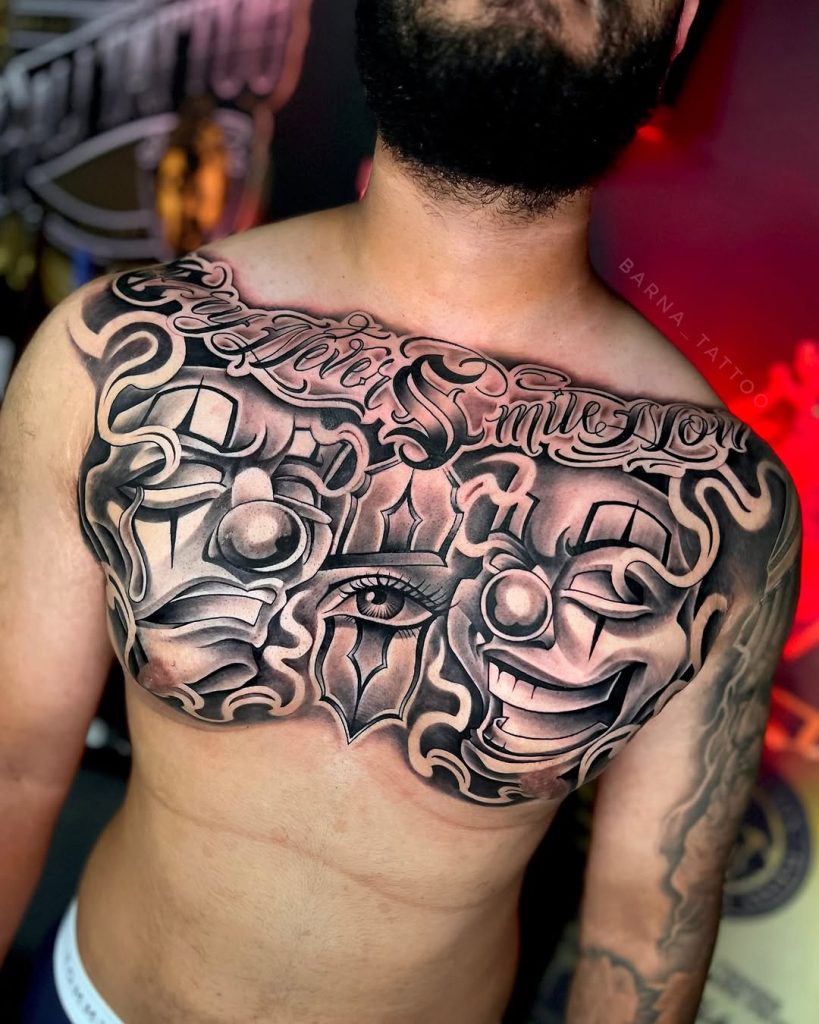
Chicano tattoos are often said to have grown out of Chicano gang culture, but today they have evolved into a distinctive style admired worldwide.
Below, we’ll explore how Chicano tattoos developed into the globally respected style they are today.
Chicano tattoos evolved alongside Chicano culture, which took shape in the United States during the 1920s–1930s.
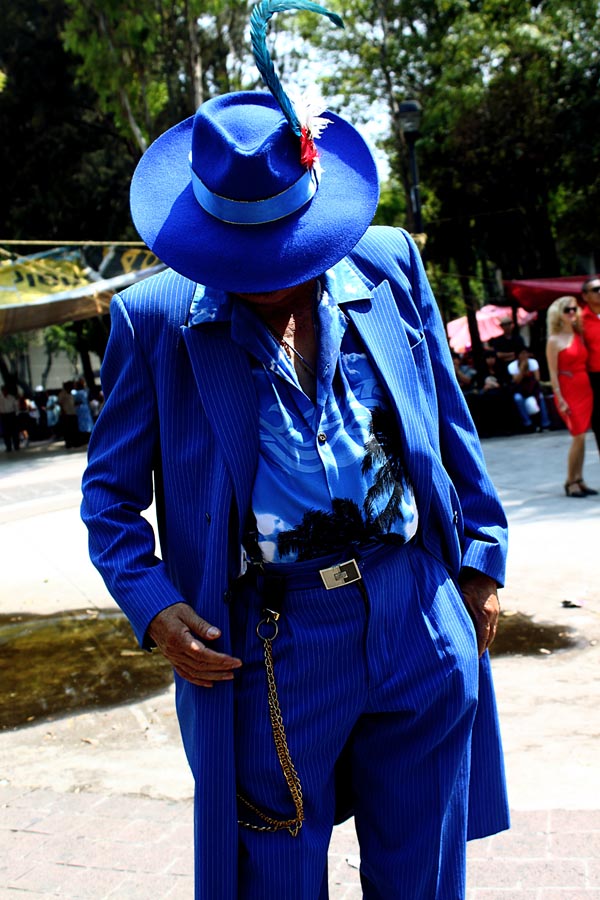
In the 1940s–1950s, a youth style known as Pachuco rose to prominence, especially in the American West.
Pachuco culture—closely tied to zoot-suit fashion and anti-assimilation identity—has often been discussed as one of the cultural predecessors connected to later Chicano identity and aesthetics.
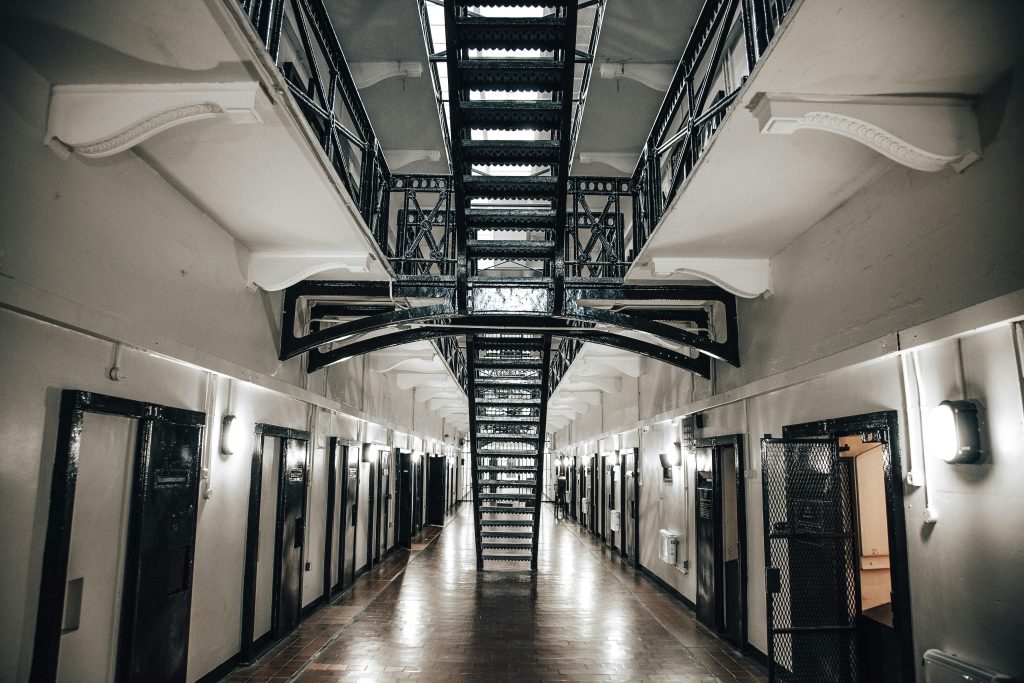
One reason Chicano tattooing became widely recognized is its connection to prison tattoo culture.
From the late 20th century onward, inmates tattooed using improvised tools and limited materials, which helped shape the refined black-and-grey look—thin lines, smooth shading, and highly controlled contrast.

As people returned to life outside, these styles spread into the broader tattoo scene.
Later, the rise of skateboarding and hip-hop culture also helped Chicano tattoo aesthetics gain international recognition.
Both Chicano and black-and-grey tattoos primarily use black ink, but they differ in theme and inte

Black-and-grey tattooing is a technique that aims for realism and painterly depth through shading, and it can be used for many subjects—portraits, landscapes, and more.
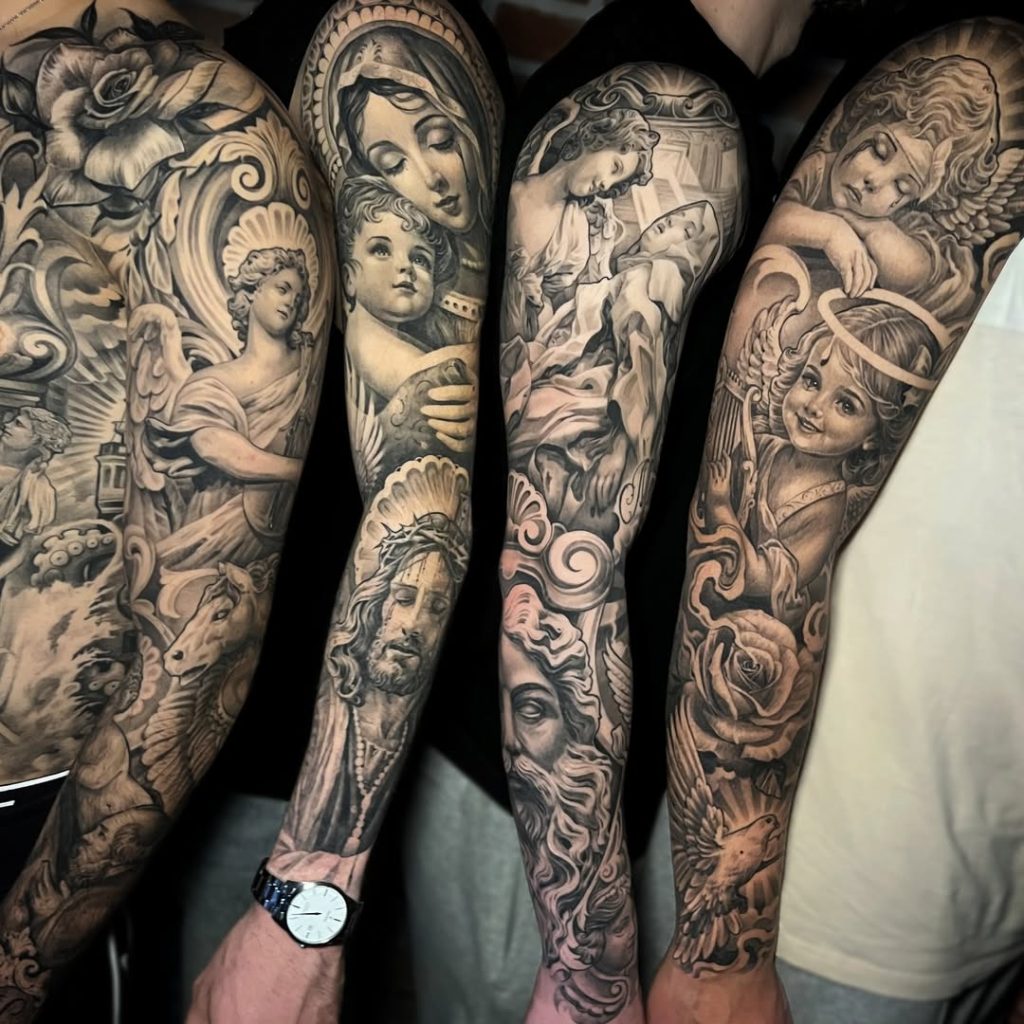
Chicano tattoos, while rooted in black-and-grey technique, stand apart by emphasizing culturally specific themes and symbols—religious imagery (the Virgin Mary, Jesus), Los Angeles urban scenery, lowrider culture, and distinctive lettering and slogans.
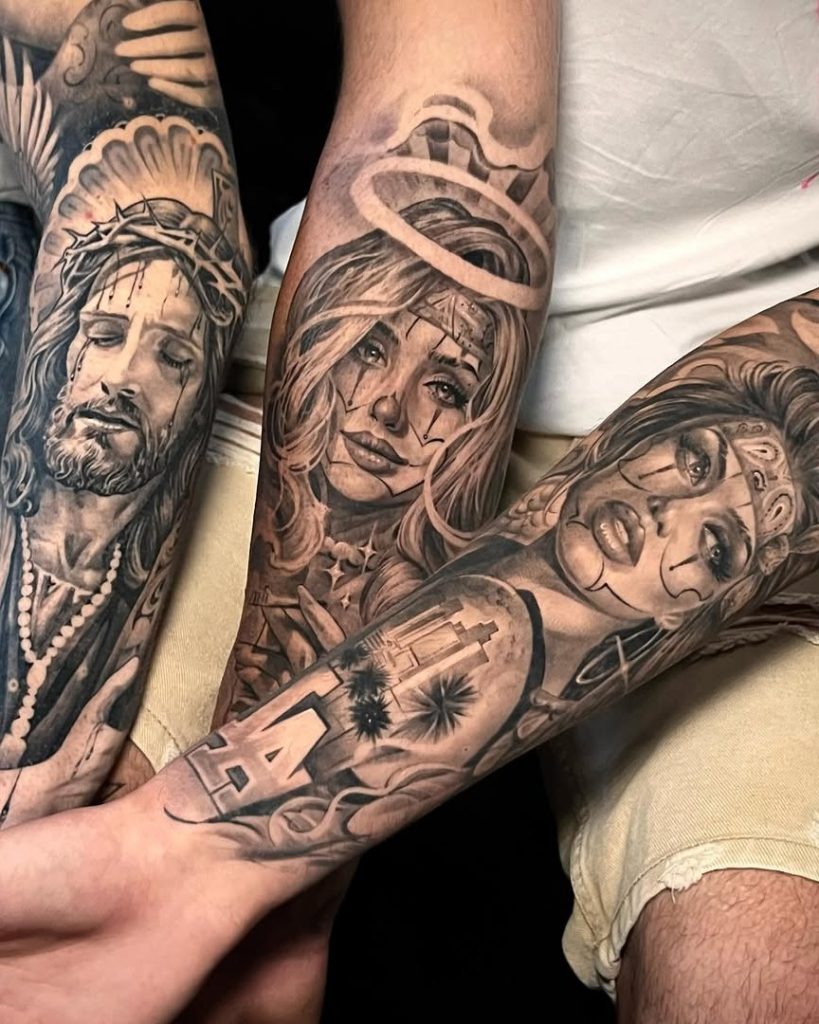
Chicano tattoos also originate from gang and prison culture, and their simple, restrained style reflects a history of being tattooed with limited tools and materials.
In short: black-and-grey often prioritizes visual realism, while Chicano tattoos are strongly tied to Chicano identity, culture, and storytelling.
From here, we’ll introduce a variety of Chicano tattoo designs.
Even within “Chicano tattoos,” the impression can change dramatically depending on the motif.
So explore and find what resonates with you.
This design combines two-face imagery (comedy and tragedy masks) with lettering—one of the most iconic Chicano tattoo styles.
The phrase “Smile now, cry later” expresses a street philosophy of resilience and duality, and has become closely associated with Chicano-style tattoo culture.
A design packed with signature Chicano motifs: a woman with her face covered by a bandana and a classic car (lowrider), both recognized icons of street and Chicano culture.
The lettering at the top—“Sacrifice”—can suggest the price paid in life: for the past, for one’s people, or for survival.
An angel with clown-like makeup holding a large amount of money—an image that highlights contrasts such as purity vs. corruption and spirituality vs. greed.
A ruined cityscape in the background can evoke the harsh reality of street life, as well as the determination to rise above it.
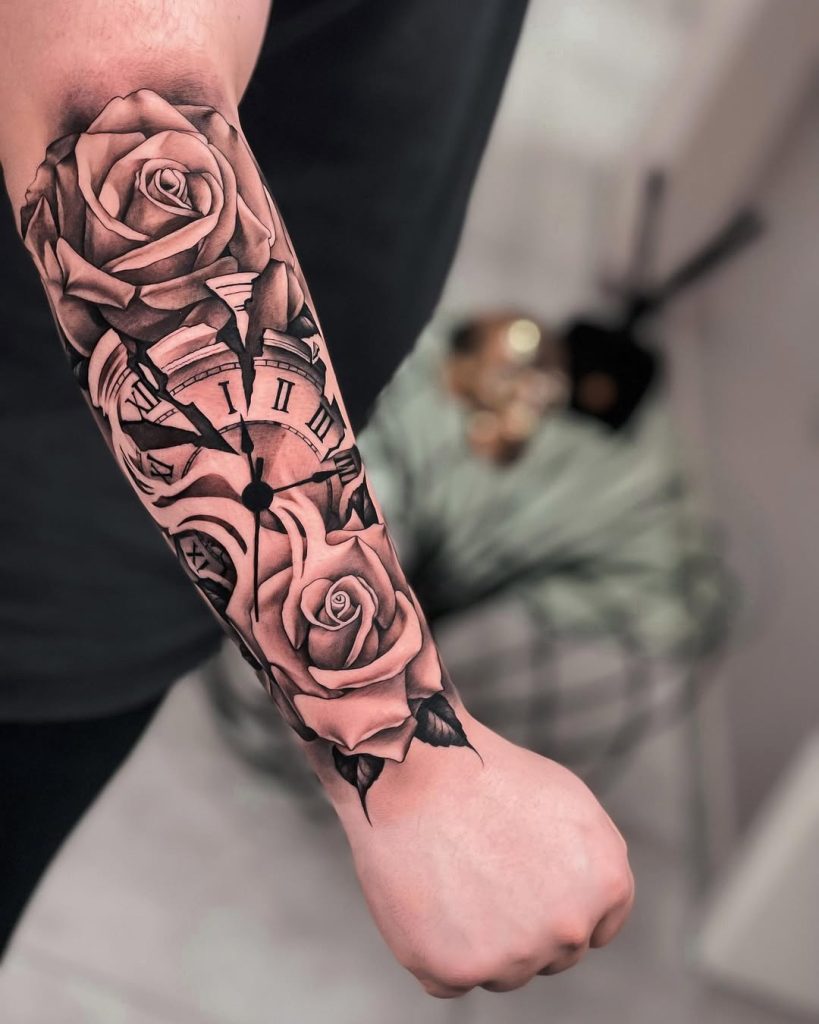
A realistic combination of roses and a pocket watch—both classic motifs.
Pocket watches often symbolize the passage of time or the fragility of life, while roses commonly represent beauty. Together, the design can suggest the beauty of a life with limited time.
Instead of using masks, this design expresses duality through contrasting angelic imagery.
Giving the “two-face” idea a different emotional tone.
A full-back Chicano design rich in symbolism.
A woman with clown makeup, plus motifs like a dove (peace), a compass (life direction), and a roulette wheel (fate and choice)ーall layered with meaning.
This is a design example of a Chicano tattoo depicting an angel with a gang-like look on the chest.
By giving the angel such a look, it contrasts purity and danger.
It can be said to be a Chicano tattoo-like design born from gang culture.
This is a Chicano tattoo design drawn as a full sleeve.
A woman with a sorrowful expression holds a smiling mask in one hand, expressing a Two-Face-like idea.
Also, on the forearm, the number “1971” and beautifully realistic roses are placed side by side, and it is thought to represent a personal anniversary or memorial.
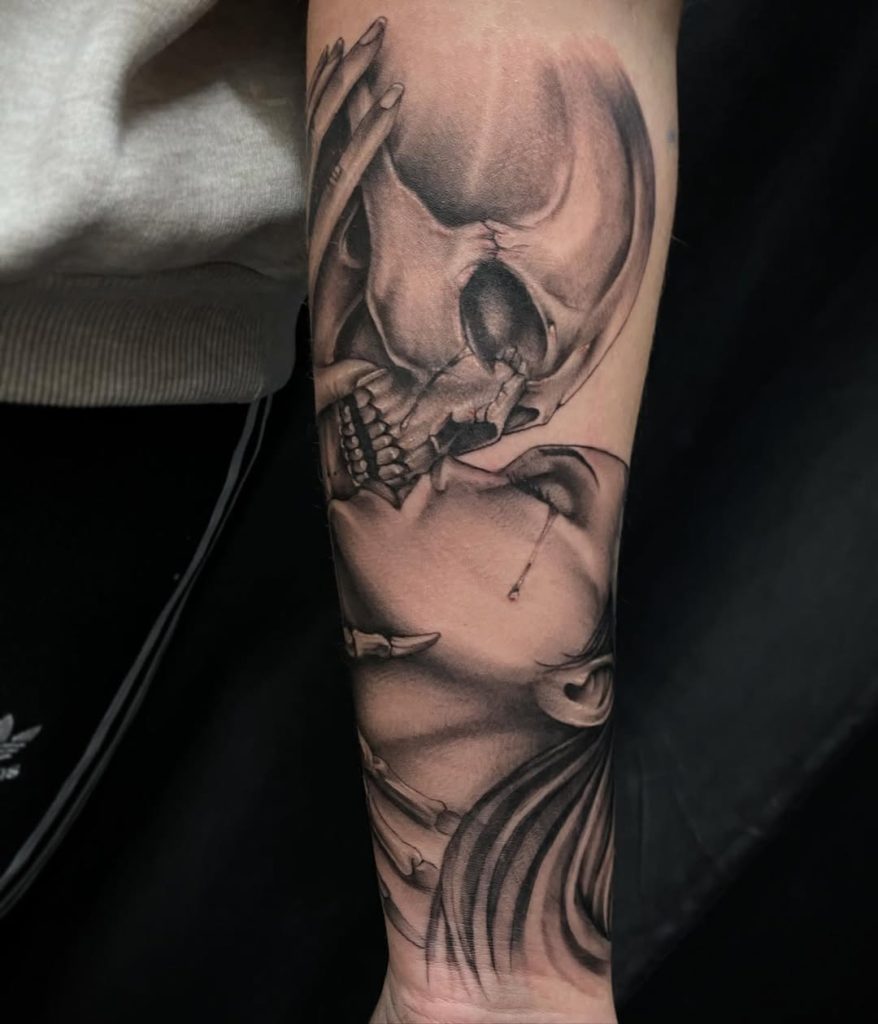
This is a Chicano tattoo depicting a skull and a woman kissing.
This composition of a skull and a woman sharing a kiss can suggest themes such as “even death is powerless before love,” or “love and death are side by side.”
The depiction of the woman’s tears quietly running down her cheek is very fleeting and beautiful.
This is a design example of a Chicano tattoo featuring a skull and the Statue of Liberty on the chest.
The Statue of Liberty is a symbol of freedom and justice, but with a bandana added, it is thought to express street culture and a spirit of resistance.
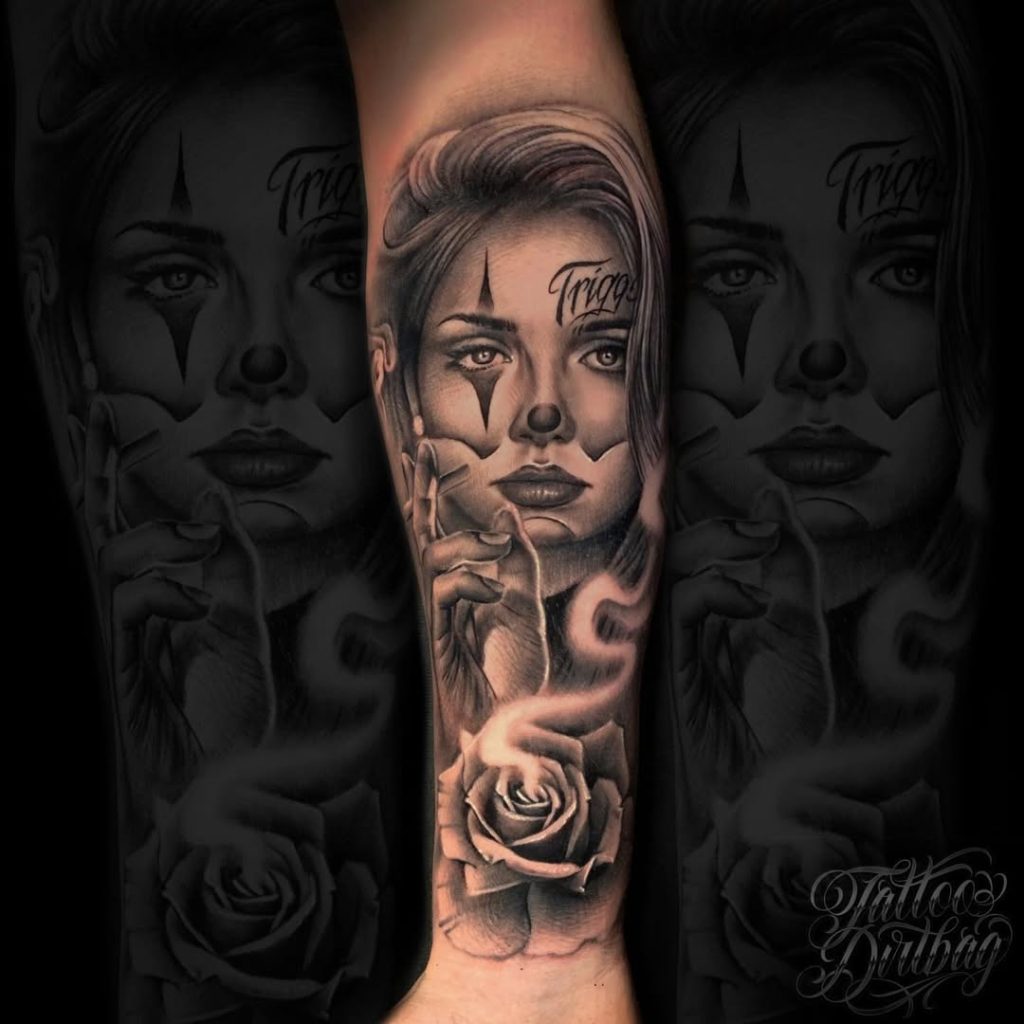
This design shows a woman with clown makeup holding a cigarette on the forearm.
Her expression has a sense of melancholy, and it matches the cigarette and the smoke very well.
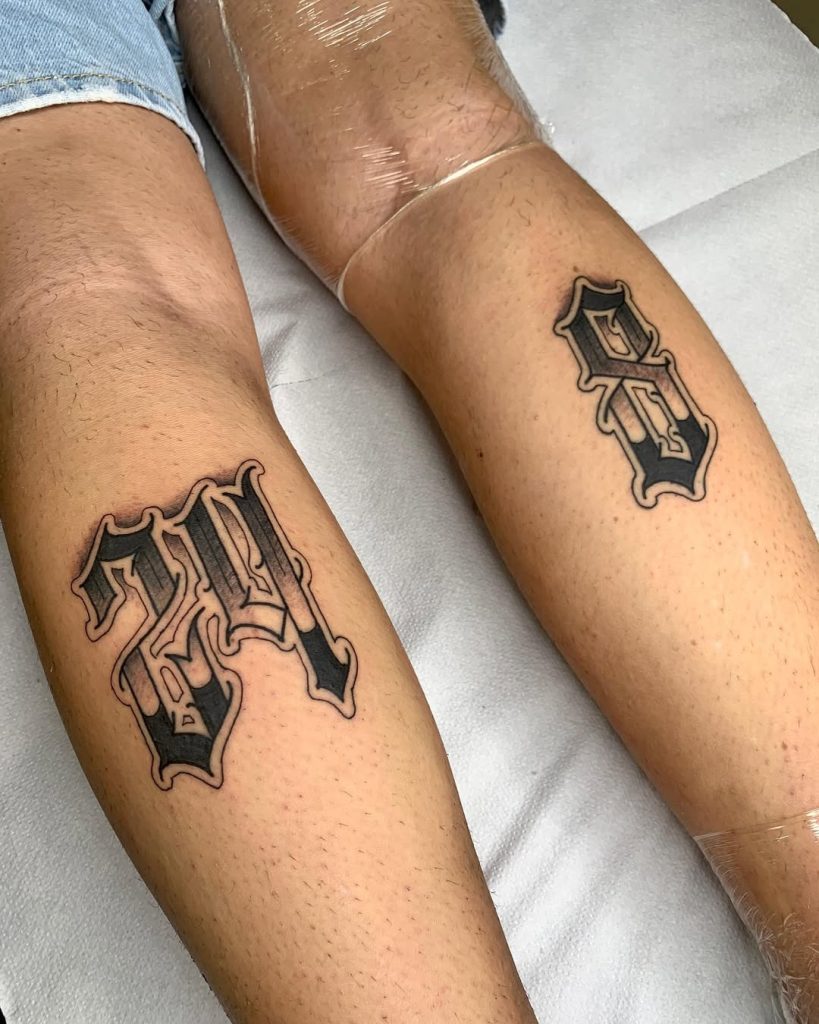
This is a design example of a Chicano tattoo with numeric lettering on the leg.
The lettering is drawn in blackletter (Old English), which is unique to the Chicano style, and it can be said to be a representative Chicano style.
This tattoo design is a script sleeve that makes full use of Chicano-style lettering, and it leaves an impression of strong messaging and beautiful typefaces.
By using different fonts for each word, a visual rhythm is created, making it an advanced lettering work that visually conveys emotion and strength.
This is a design example of a Chicano tattoo with lettering on the face.
This face tattoo combines the name “Lisa” with a crown motif in a Chicano style.
Name tattoos are a representative style that expresses respect and bonds with loved ones, and placing it on the face makes you feel the strength of that feeling and the determination.
This is a Chicano tattoo combining a clown-makeup woman and playing card motifs on the calf.
Even though she wears clown makeup meant to entertain people, the woman’s composed expression is a very memorable part of the piece.
This chest tattoo is a heavy piece that strongly pushes forward a “gang-like / underground” theme even within the Chicano style.
The overall impression is intense, but the very detailed depiction and composition make you feel the artist’s high level of skill.
This full-back Chicano tattoo is a design that fuses overwhelming visual impact with strong messaging.
Centered on a clown-makeup woman, a pocket watch, smoke, and a spray can are arranged, and it is thought to express the passage of time, street culture, and a rebellious spirit.
And in the lower right, bold lettering reading “Don’t look back (Don’t look back)” is added, making it a piece that conveys a strong will to “move forward without being trapped by the past.”
This is a tattoo design with one-point-size lettering on the ankle.
Chicano style has various fonts, but thin and elegant fonts like this are also easy for women to get.
This is a one-point tattoo depicting the motif of “praying hands” on the ankle.
Though small, these hands are delicately drawn and express meanings such as “faith,” “hope,” and “prayers for family and one’s people.”
It is also considered a representative motif in Chicano culture.
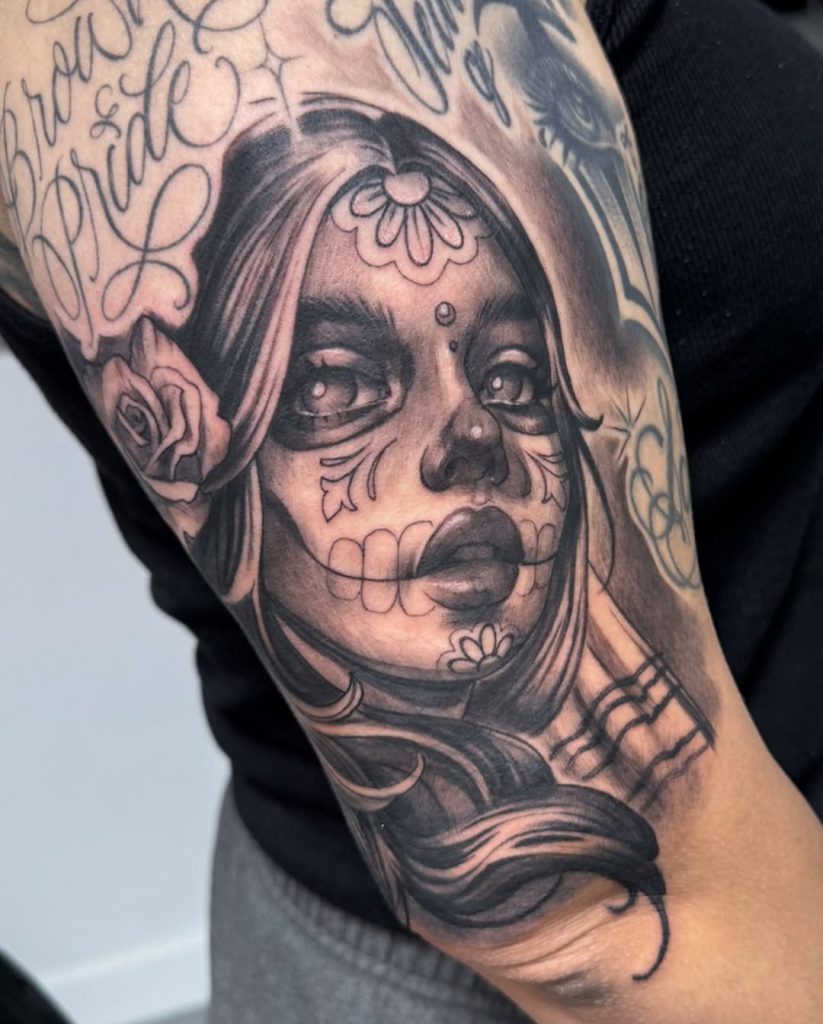
This tattoo is a Chicano-style piece beautifully depicting “La Catrina,” an iconic presence associated with Mexico’s Day of the Dead (Día de los Muertos), on the arm.
Sugar skull–style decorations are added to the face, symbolizing death and rebirth, as well as respect for ancestors.
バラの髪飾りや柔らかな表情には、哀悼とともに誇りや女性の力強さも感じられます。