Centipede Tattoo Meaning: Tribal, Higanbana, and Japanese-Inspired Design Ideas
2026/04/28
2026/04/29
2026/04/29



The centipede has long been seen as a creature that symbolizes fear, intensity, and raw vitality—thanks to its distinctive form and relentless movement.
In tattoo culture, centipede tattoos pair especially well with bold styles such as Japanese irezumi, blackwork, and tribal designs. The long body and countless legs also make it a perfect motif for “crawling” compositions that wrap naturally around the arm, leg, neck, or back, creating a strong visual impact.
In this article, we’ll cover the core meaning of the centipede tattoo, plus popular design directions—such as red spider lily (higanbana) pairings and Noh mask concepts.
A centipede tattoo is commonly associated with meanings such as vitality, tenacity, aggression, forward momentum, and protection.
Because centipedes move quickly and persistently—pushing forward with countless legs no matter the terrain—they often represent the mindset of never giving up and continuing to advance through adversity. For that reason, many people choose this motif to express unwavering conviction or the strength to overcome difficult situations.
Centipedes are also known for their venom, which adds another layer: the tattoo can project danger, intimidation, and a “keep your distance” aura. Visually, the elongated body and leg structure make it easy to create a dramatic crawling layout across the skin, which naturally boosts the tattoo’s intensity.
In Japan, centipedes are sometimes discussed in connection with warriors and Bishamonten (a deity associated with battle and protection). Because the centipede is seen as a creature that doesn’t retreat and keeps moving forward, it may also be interpreted as a symbol of good luck in competition, winning momentum, or even prosperity and money luck.
We’ll introduce centipede tattoo design ideas.
Design approaches vary widely—from realistic centipede pieces to tribal-styled arrangements, and Japanese-inspired combinations such as higanbana and Noh mask centipede concepts.
Consider the meaning you want to emphasize and the body placement you prefer, then choose a design direction that feels right for you.
This is a highly striking design that combines iconic Japanese motifs—centipede, Hannya, and higanbana—into one composition.
The Hannya mask at the center is rendered with strong shading for a three-dimensional feel, and the sharp eyes and fangs leave a powerful, tense impression.
The centipede placed above is carefully detailed down to the segments and legs, creating a finish that feels both unsettling and strong at the same time.
The flowing layout also adds motion throughout the piece, which is one of the most distinctive strengths of this composition.
This is an American traditional centipede tattoo, defined by bold outlines and a simple color structure that creates a classic, highly readable finish.
Even with simple design, it captures the signature toughness and strong design sense that traditional work is known for.
A bold American Traditional concept that merges a centipede motif with skull elements.
The black-based body is accented with red legs and details, creating the high-contrast color balance that Old School designs are known for.
This is a Japanese-inspired tattoo design that combines a Noh mask with a centipede motif.
By wrapping a twisting centipede around a quietly expressive face, the piece achieves a unique worldview where eeriness and beauty coexist.
This is a hard-hitting Japanese-style tattoo that combines a centipede with a severed head motif.
The bold layout fills the abdomen and delivers a powerful, attention-grabbing impact.
This is a realistic centipede tattoo placed from the neck up toward the underside of the jaw.
Drawn to crawl along the body’s natural lines, it creates an intense sense of realism—almost as if it’s actually moving.
This realistic centipede tattoo is placed from the chest up toward the shoulder.
Its slim, sharp silhouette enhances the unsettling realism, giving the impression of something creeping over the skin.
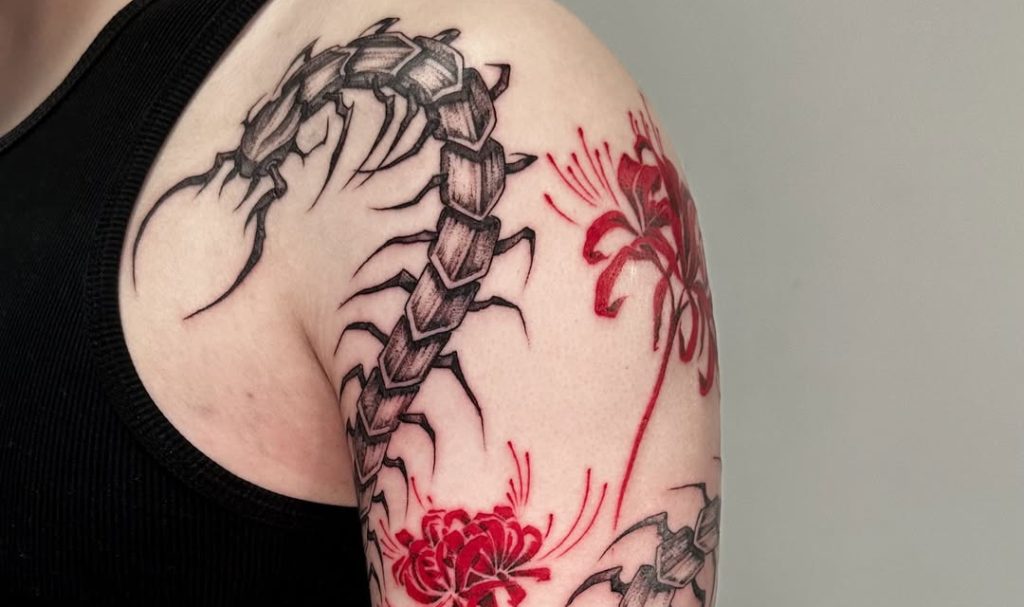
This tattoo design pairs a centipede with higanbana, emphasizing a dark Japanese aesthetic.
Rendered in black and gray, the centipede features thorn-like legs and bone-like styling that leans slightly abstract and aggressive.
This is a Japanese-inspired realistic tattoo combining a centipede and higanbana.
The composition follows the arm’s flow naturally, allowing the centipede’s movement to read especially clean and elegant.
This bold black and gray tattoo places a centipede and higanbana from the neck down toward the chest.
The centipede spans a wide area, yet the flowing composition keeps the overall design cohesive and highly commanding.
The higanbana at the throat adds both softness and eeriness, balancing the piece beautifully.
This is a centipede-inspired tattoo design created by linking multiple Noh masks.
The concept of using Noh masks as the “segments” is highly original, blending traditional Japanese aesthetics with an unsettling edge.
This tribal centipede tattoo is boldly placed from the shoulder down across the upper arm.
Built with flowing lines, the layout follows the body’s contours naturally, which makes the placement feel especially clean.
This Japanese-style tattoo combines higanbana with a centipede motif.
The vivid red higanbana takes center stage, while a simplified centipede is placed along the stem in clean lines—strongly emphasizing a vertical flow.
It keeps a Japanese feel without leaning too heavily into traditional styling, which gives the piece a more art-forward finish.
The seductive atmosphere of higanbana and the toxic edge of the centipede harmonize into a distinctive, memorable design.
This tribal centipede tattoo stretches in a crawling motion from the chest across the shoulder and down the arm.
The dynamic composition follows the body line boldly and naturally guides the viewer’s eye across the piece.
This is a powerful leg tattoo that places a realistic centipede along the full length of the leg.
The vertical layout heightens the realism, giving it a vivid, crawling sense of presence.