Japanese Traditional Tattooing – Explaining the Difference from Tattoos, Prices, and Popular Designs
2023/10/11
2026/03/02
2026/03/02



“Irezumi,” or Japanese traditional tattooing, has gained recognition not only in Japan but also overseas in recent years. According to one theory, it is a traditional Japanese tattoo style that has existed since the Jomon period.
In this article, we will thoroughly explain everything from the difference between Japanese traditional tattooing and tattoos, to price ranges, popular designs, and their meanings.
*Please note that some parts are based on subjective views.
*Generally, Japanese traditional tattooing is also called “shisei,” “irezumi,” or “traditional Japanese tattooing.” In this article, we use the term “Japanese traditional tattooing” / “wabori” in order to differentiate it from tattooing used as punishment, and also because it more clearly evokes traditional Japanese tattooing.
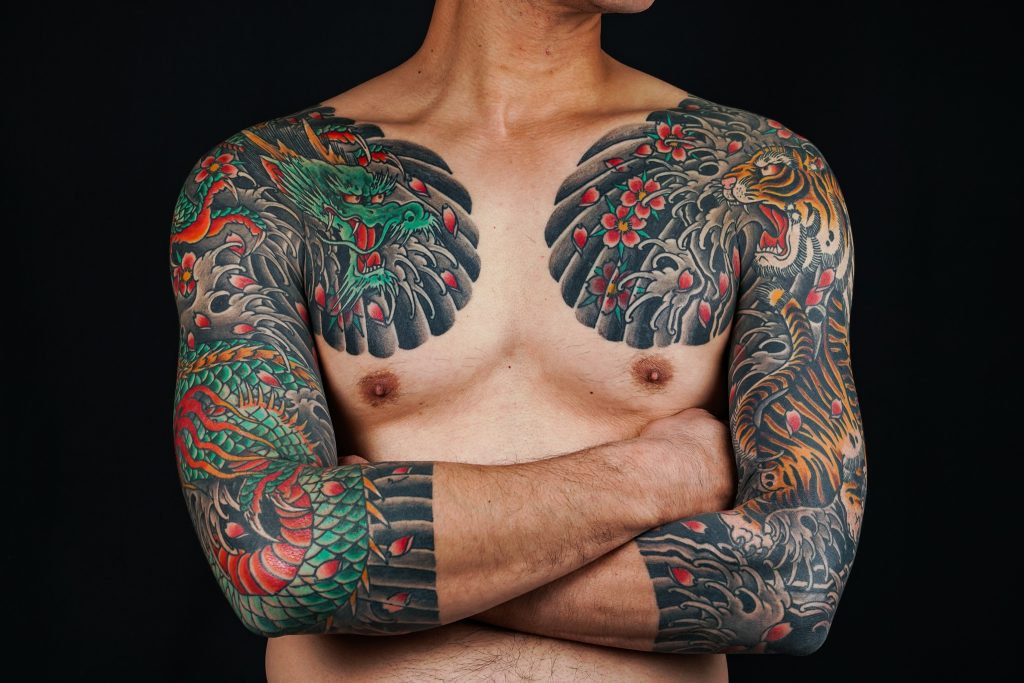
In Japan, Japanese traditional tattooing was most popular during the Edo period(A.D. 1,600 – 1,868). At that time, tattooing was used as a criminal punishment, but a major turning point came when the Chinese novel “The Water Margin(水滸伝)” became a huge hit. The vividly colored body art carried by the characters in that story spread among the public as a symbol of “manliness.”
However, later, going into the Meiji period(A.D. 1,868 – 1,912), it came to be recognized as something associated with antisocial elements, and a “tattoo prohibition order” was issued. Even under those circumstances, tattoo culture did not die out among the stylish and hot-blooded outlaws of the time, and from that flow, tattooing came to be recognized as something “scary.”
Then what exactly makes something Japanese traditional tattooing? Generally, it is said to be Japanese motifs drawn using traditional techniques such as “powerful outlines,” “shading,” and “background framing / edge work (mikiri).”
However, strictly speaking, is neo-Japanese tattooing / neo-Japanese style also Japanese traditional tattooing? Also, while tattoos were hand-poked in the Edo period, do those done with machines also count? These are points on which opinions differ. Therefore, there is no single unified, clear definition of Japanese traditional tattooing.
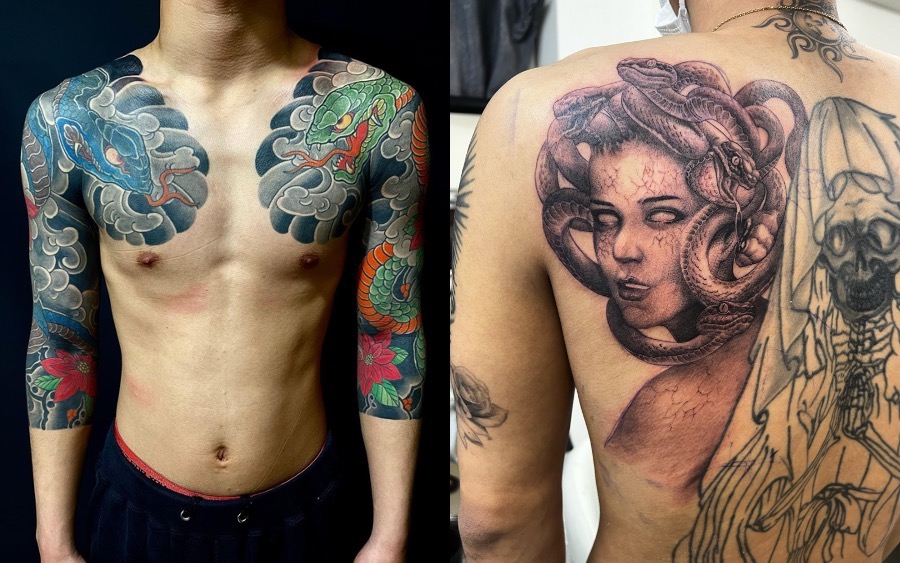
Then what is the difference between Japanese traditional tattooing and tattoos?
Based on the explanation above, tattoo work using Japanese-style motifs and techniques can be thought of as Japanese traditional tattooing, and everything else can be thought of as tattoos. However, just as the definition of Japanese traditional tattooing is not fixed, there is also no clearly established difference.
Some people define it by the depth of the needle, the use of Japanese motifs, or the presence of outlines and shading as mentioned above, while others define it more strictly. So in the end, the answer is that it depends on the person.
A large Japanese traditional tattoo such as a full-back piece, as people commonly imagine, is basically priced by the hour.
In other words, it is calculated as ○○yen per hour × however many hours it takes.
Below are rough guides by size, but please keep in mind that these are only rough estimates.
Assuming the average hourly rate of a tattoo master is “10,000–20,000 yen per hour,” and estimating session time, the approximate prices would be as follows.
| Placement | Session time | Estimated price |
| Chest to arm: three-tenth sleeve | 15–18 hours | 150,000 yen–360,000 yen |
| Chest to arm: half sleeve | 18–24 hours | 180,000 yen–480,000 yen |
| Chest to arm: seven-tenth sleeve | 24–28 hours | 240,000 yen–560,000 yen |
| Chest to arm: nine-tenth sleeve | 28–35 hours | 280,000 yen–700,000 yen |
| Back, outline-only / no full background | 30–40 hours | 300,000 yen–800,000 yen |
| Back with full background framing | 40–65 hours | 400,000 yen–1,300,000 yen |
In addition to this, there may also be separate charges for the stencil drawing and consumables such as needles.
Also, the price may go up or down depending on the level of detail in the motif and the size of the body.
That said, Japanese traditional tattooing is basically something you live with for life, so choosing only by price is very dangerous. We recommend deciding without compromising on price, after considering the size of the motif you want and the artistic style of the tattoo masters.
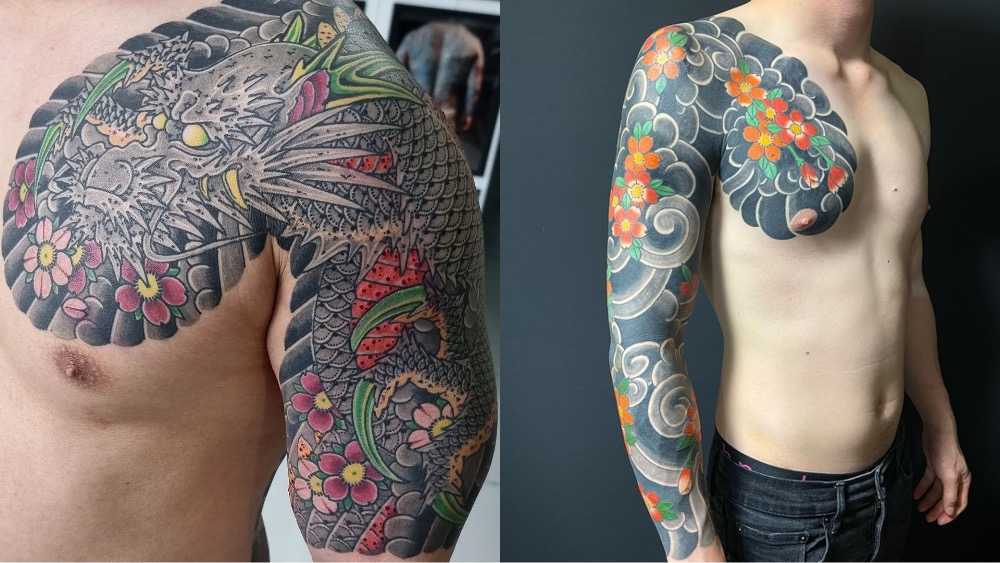
The composition of Japanese traditional tattooing can be broadly divided into Kanto style and Kansai style.
Kanto style (left image) has narrow edge framing, and the chest panel curves above the nipple. On the other hand, Kansai style (right image) has thicker edge framing, and the chest panel reaches below the nipple.
However, there was a famous tattoo master named “Horiuno1(初代彫宇之)”, active in Kanda from the Meiji to Taisho periods, and tracing back his lineage, it is said that his master came from Kansai. In that sense, it is difficult to divide things clearly into Kanto and Kansai, so please think of this only as one way of looking at it.
Besides these, there are also compositions such as open-chest style and full-body tattooing (“donburi”).
The designs used in Japanese traditional tattooing each carry meanings that have developed along with history.
When choosing a motif, why not think not only about the design itself, but also about the meanings and feelings contained in the motifs introduced below?
Here we will introduce motifs that are often used in movies, dramas, and recently also in games.
Because these are popular motifs, the subject matter may overlap with other people’s, but they contain the kind of appeal that makes them popular. Also, even with the same subject matter, the motif can show many different expressions depending on the tattoo master’s sensibility and sense, so I do not think there is any need to worry too much about overlapping themes.
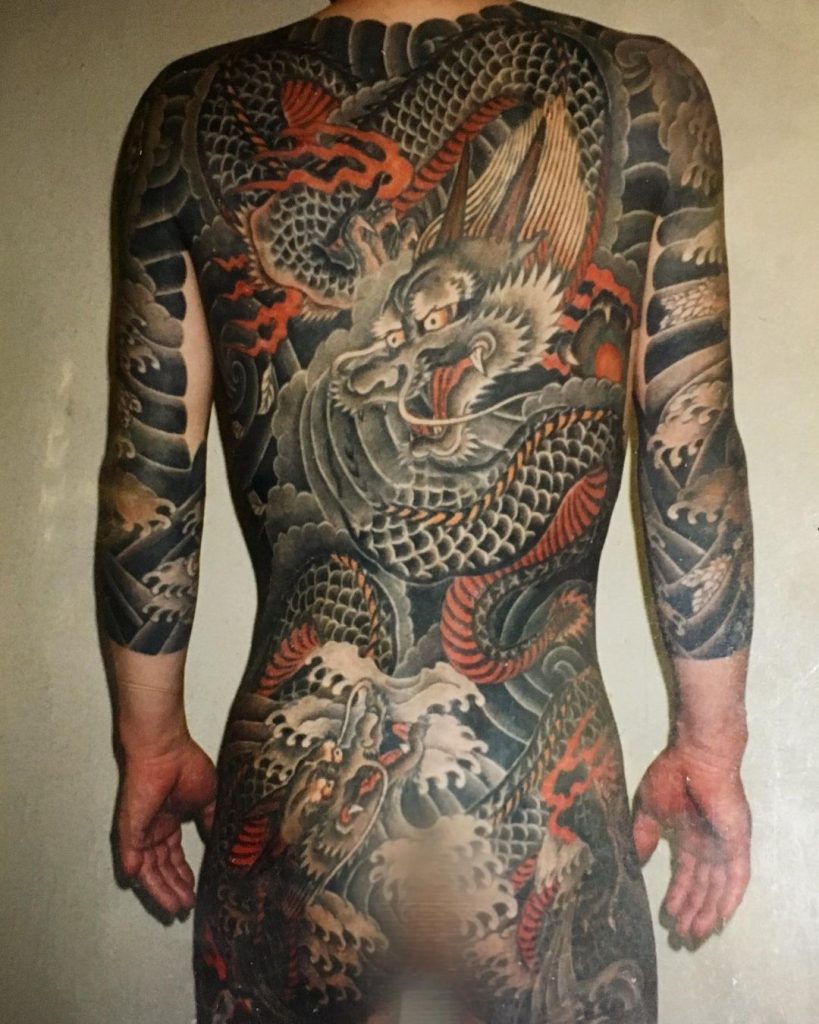
The dragon has the meaning of “success / rising in life,” and it is said that dragons begin with three claws, with five claws being the highest form.
Strictly speaking, there are various kinds such as ascending dragons, descending dragons, blue dragons, yellow dragons, and black dragons, so even when simply called “dragon,” the meaning changes. Also, the Chinese-derived dragon and the Western dragon are not the same. Therefore, the meanings in the West are different as well.
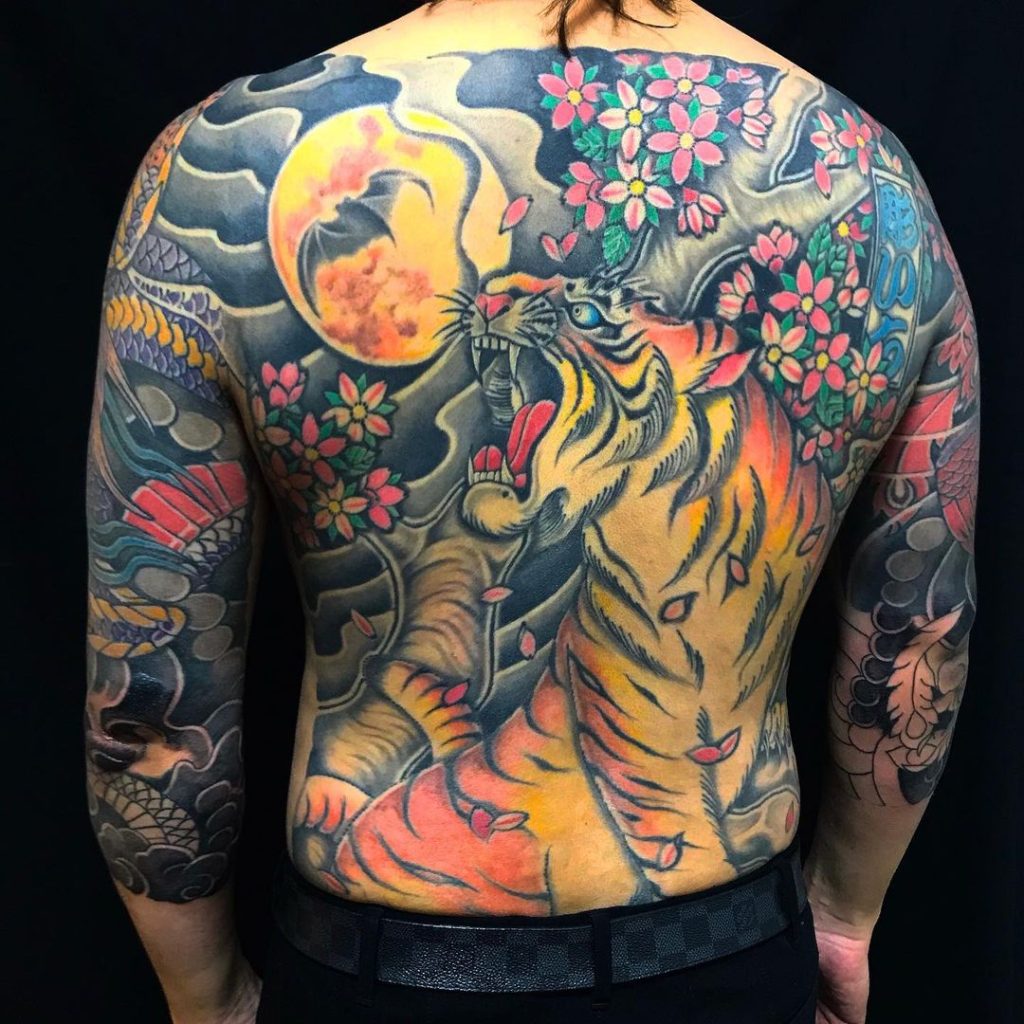
The tiger generally has meanings such as “bravery,” “strength,” “power,” “authority,” and “improved financial luck.”
As expressed in the term “dragon and tiger,” the tiger is considered the counterpart to the dragon: the dragon is said to represent spiritual strength, while the tiger represents physical strength. It is a popular design not only in Japan but also overseas.
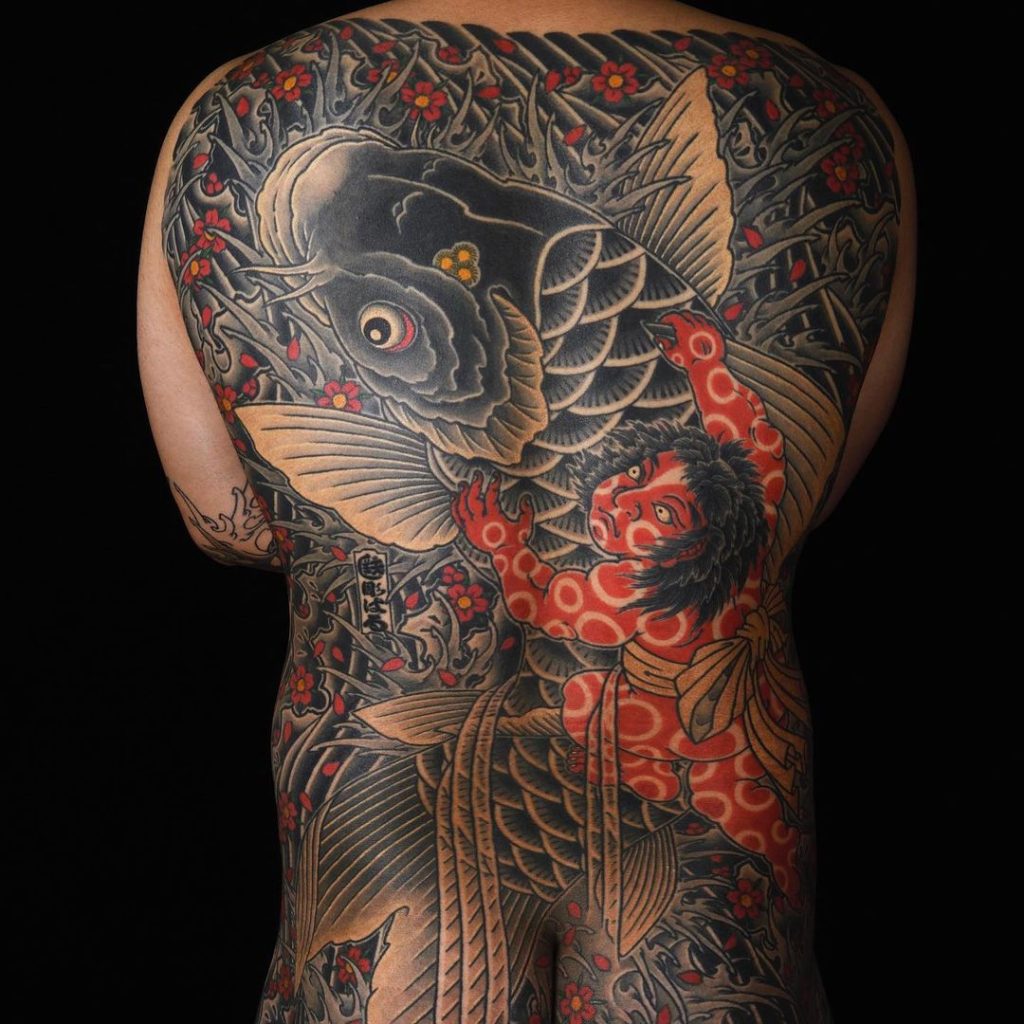
The carp has long been one of the most popular motifs. Its popularity is not limited to Japan; because overseas artists were captivated by Japanese-style carp designs, it has become popular around the world as well. That is why in tattoo culture it is often called not simply “carp,” but “koi fish.”
Just as there is a legend that “a carp that climbs a waterfall becomes a dragon,” the carp is known as a symbol of “success / rising in life.” Also, the design called “Dragon Gate,” which combines a carp and a dragon, is popular for the same reason.
It also has meanings such as “longevity,” “courage,” and “perseverance.”
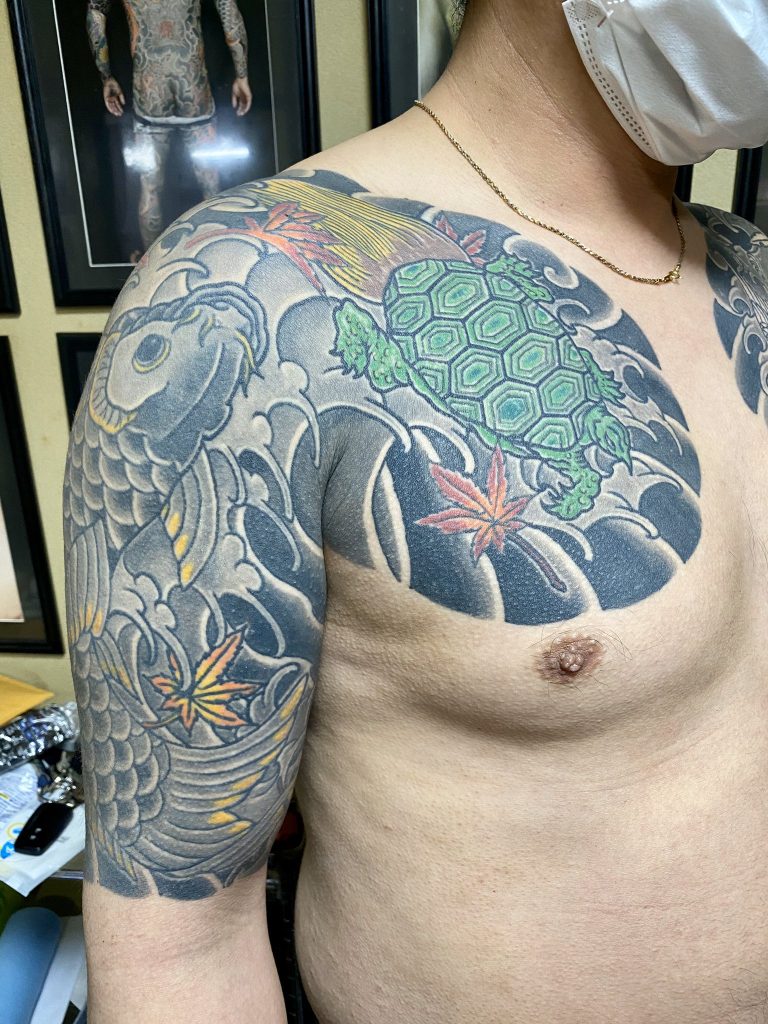
As in the saying “A turtle lives a thousand years,” the turtle is a symbol of immortality and longevity.
Also, Genbu (the Black Tortoise / spiritual turtle), one of the Four Symbols of Chinese mythology and a legendary divine beast, is also based on a turtle.
Generally, Genbu is depicted in various forms, such as a turtle with a snake wrapped around its body, a snake tail, or just a turtle alone.
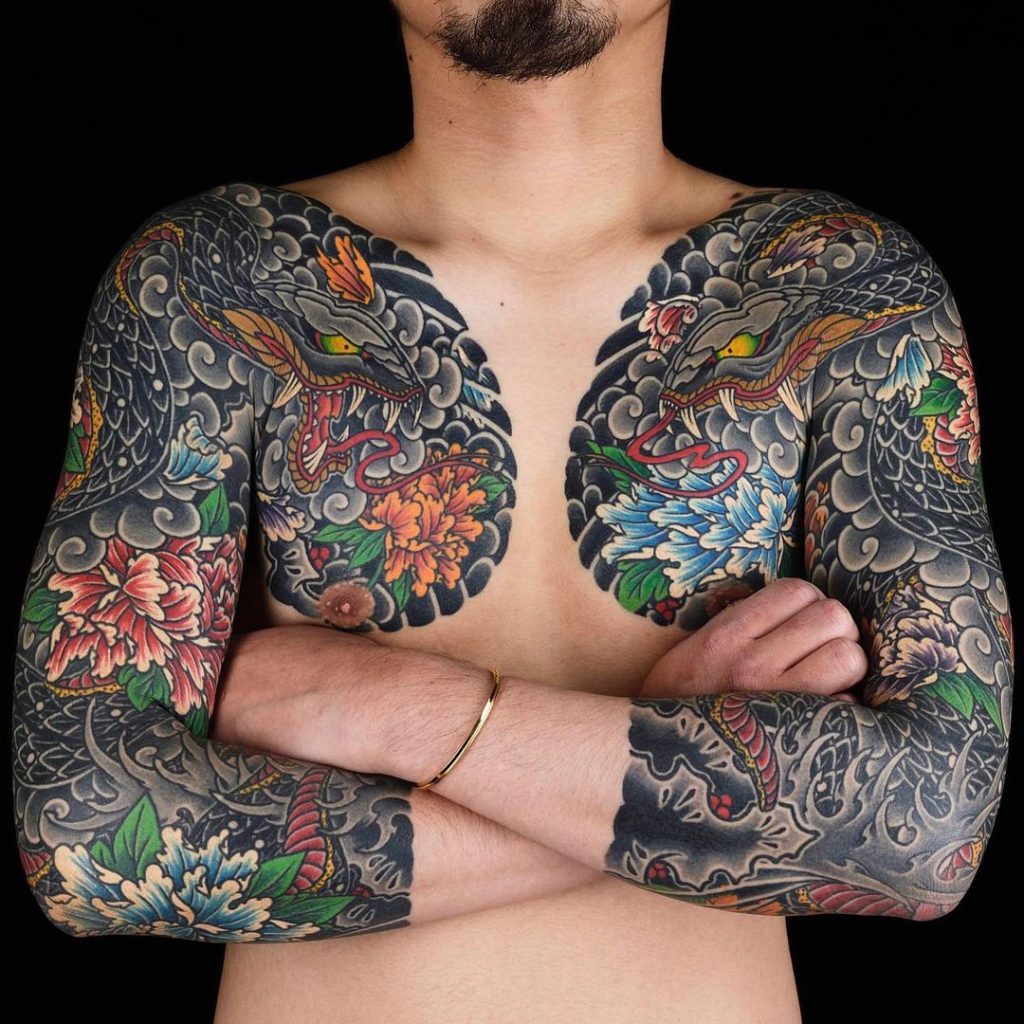
Because snakes repeatedly shed their skin and are reborn, they are symbols of immortality. For that reason, meanings associated with snake designs include rebirth and eternity. Also, in Japan, snakes have long been objects of worship.
A representative example is Yamata no Orochi, the giant serpent with eight heads. In “Japanese Records of Ancient Matters”, it appears as a monster that eats human maidens, and there is a story in which Susanoo no Mikoto, the younger brother of Amaterasu Omikami(the Sun Goddess, is the supreme deity in Japanese mythology and Shintoism), defeats it. This Yamata no Orochi can also be seen as a type of snake worship, a deified being in which the superhuman threats caused by nature—such as mountains and rivers—were likened to a snake.
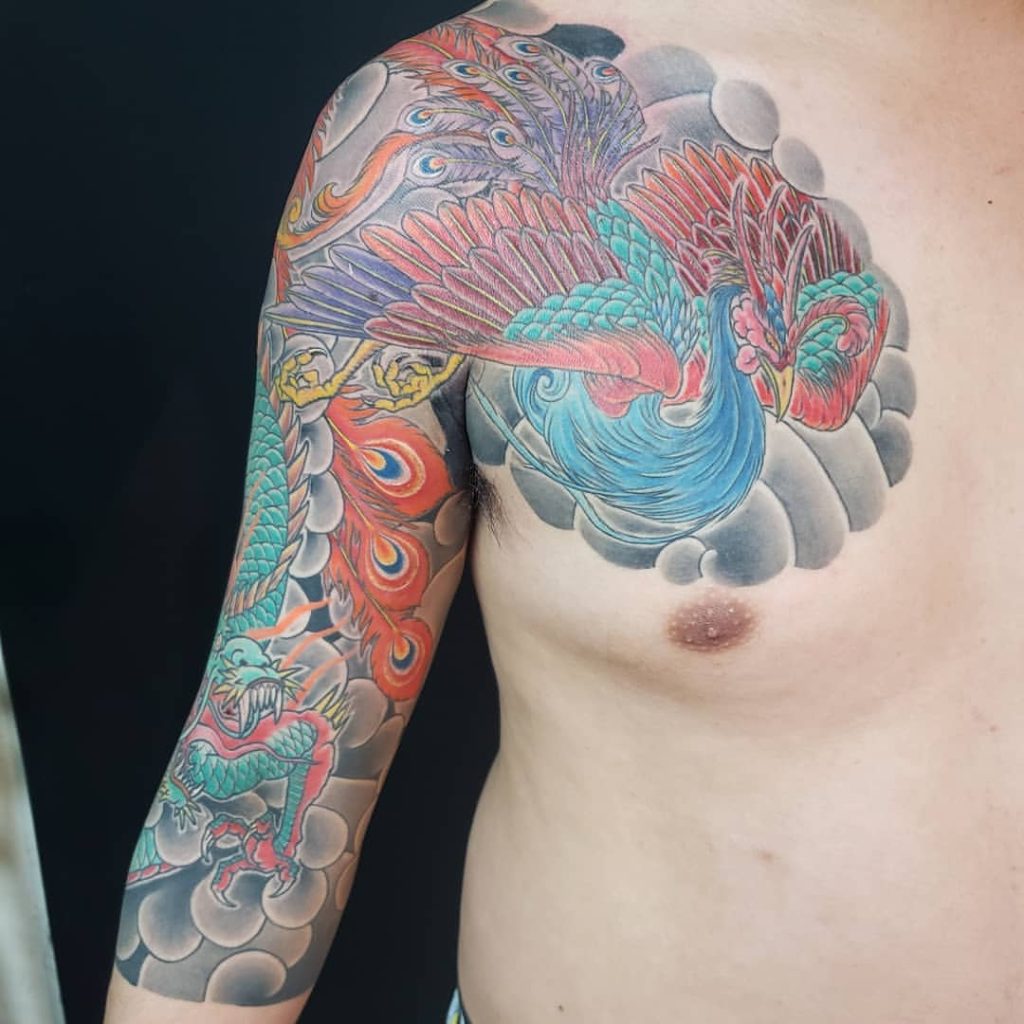
Like Genbu, the Chinese phoenix is one of the Four Symbols of Chinese mythology, and its meanings include the arrival of happiness, splendor, and compassion. In Chinese tradition, the phoenix is said to have gorgeous five-colored feathers (red, yellow, blue, white, and black), and it is considered a symbol of peace under heaven. Because of its vivid appearance, it is also a motif popular with women.
Also, it is often confused with the Western phoenix, but the Chinese phoenix and the Western phoenix are entirely different things—the former is of Chinese origin, while the latter comes from ancient Egypt—so need to be careful.
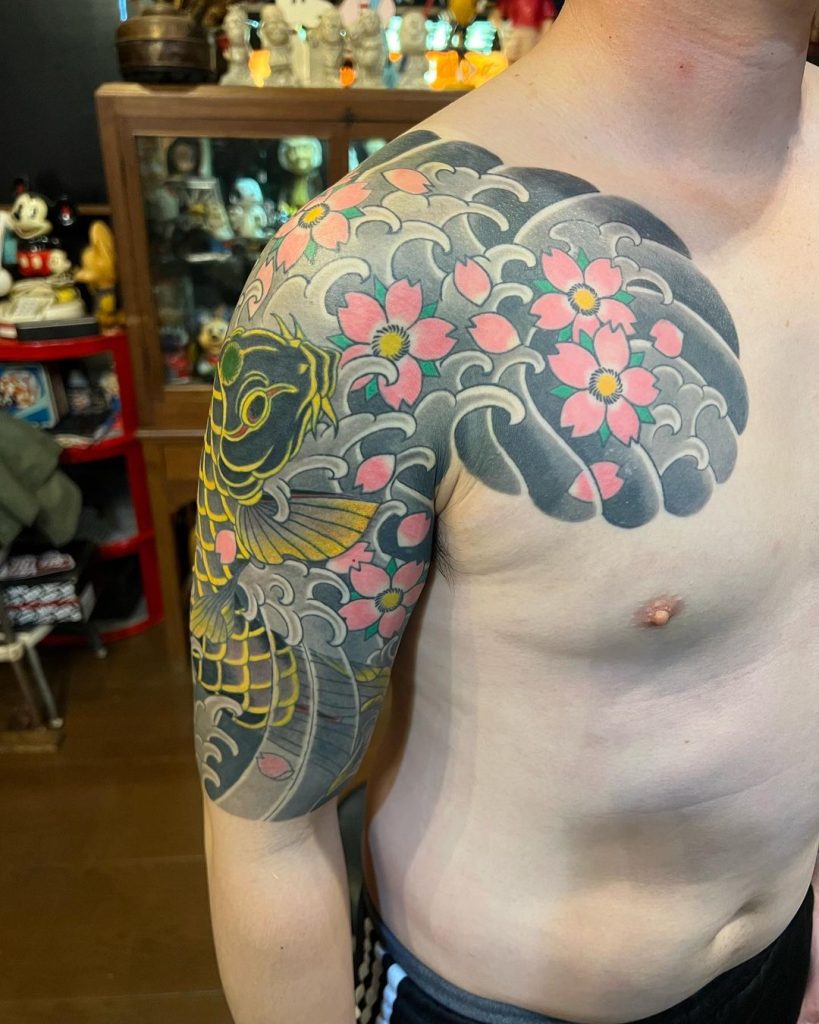
Because cherry blossoms fall only about a week after blooming, they are considered symbols of the transience of life. This connects to the Buddhist idea of impermanence: that life is fleeting and nothing lasts forever.
Also, the flower meanings of cherry blossoms are “beauty of spirit,” “graceful woman,” and “purity,” making them an easy motif for women to get as well.
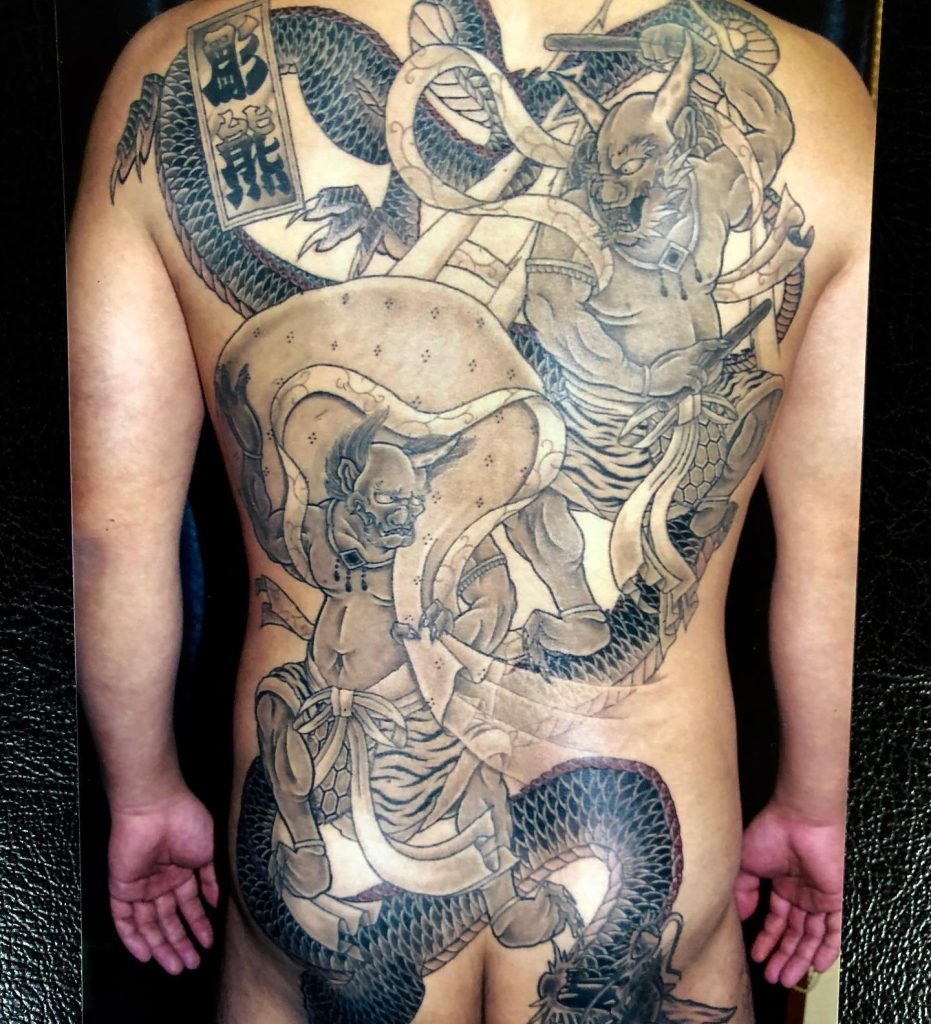
These two deities were originally transmitted from India to Japan, but in Japan they were considered evil gods. However, after being defeated in battle by Thousand-armed Kannon, they became benevolent gods by promising to devote themselves to people.
For that reason, Fujin and Raijin have the meaning of protection.
In addition to the popular designs introduced above, there are also so-called auspicious motifs that carry surprising good-luck meanings. Below, we will introduce the meanings of such auspicious motifs.
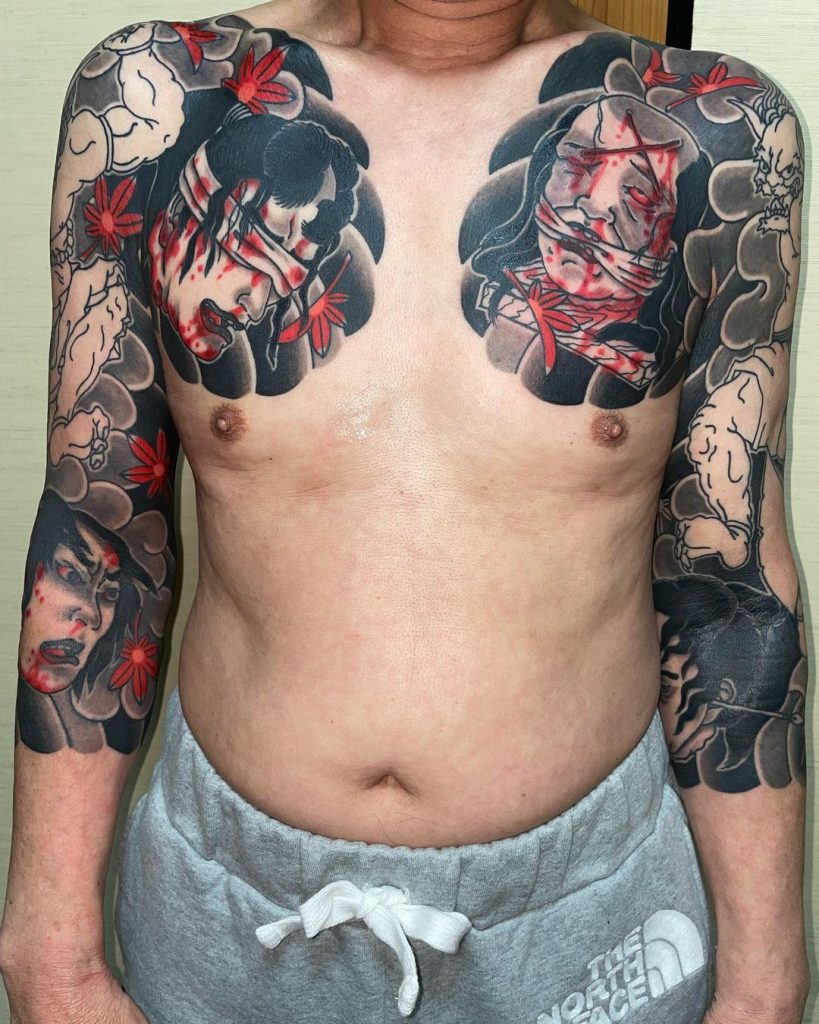
The severed head has long been familiar as a motif in traditional Japanese tattooing.
During the Sengoku period(A.D. 1,467 – 1,615), when samurai defeated a famous enemy general, they would bring back the head as proof. Therefore, in order not to lose their own heads, and to pray for martial fortune, they would put embroidery or crests of severed heads on their battle surcoats. Because of this, the severed head motif came to serve as protection against evil.
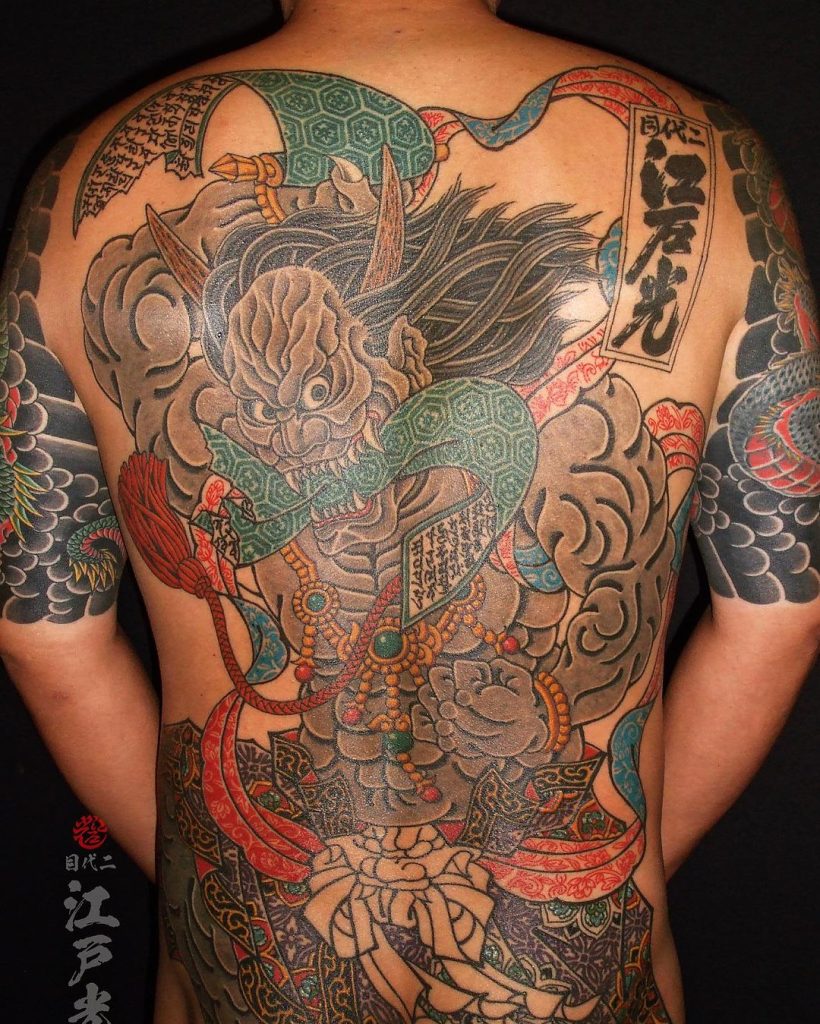
Oni are representative supernatural beings of Japan, but depending on the story, they can be good, divine, or otherwise take many forms.
Oni are thought to possess special spiritual power, and by borrowing that power to keep evil spirits away, they are considered auspicious motifs.
Also, in Buddhism there are two types of demon deities: benevolent and malevolent. Famous benevolent demon deities include Bonten, Taishakuten, and Ashura.
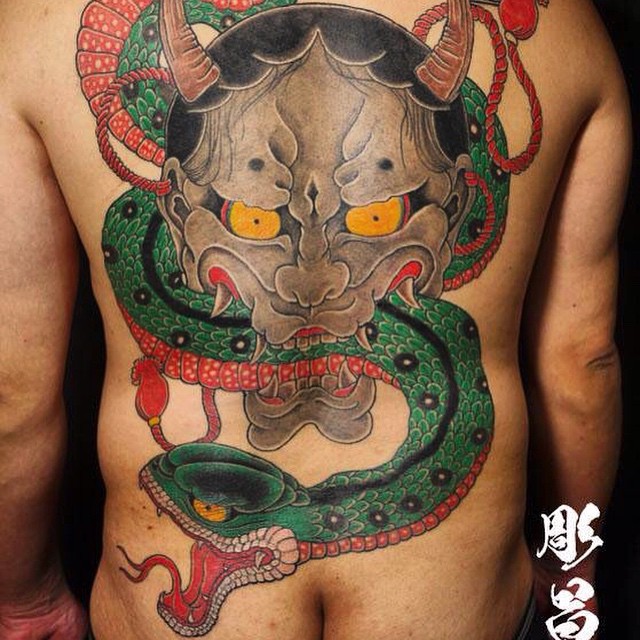
Originally, “hannya” in Buddhism refers to the wisdom obtained through enlightenment. What is called “hannya” in Japanese traditional tattooing refers to the Hannya mask.
The Hannya mask is a Noh mask used in traditional Japanese performing arts, with two horns and two sharp fangs above and below. It is based on the face of a woman who became a demon through jealousy and resentment. Therefore, the Hannya mask is used to express mental states and the full range of emotions. It also seems to have meanings such as warding off evil.
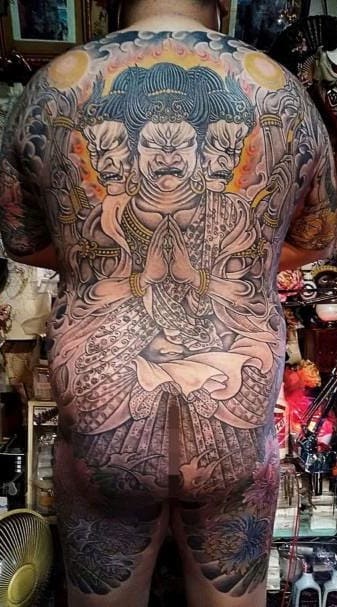
Ashura is a family of gods from ancient India—an evil god that loves conflict and challenges the heavenly gods to battle. With three faces and six arms, it has a very fearsome appearance befitting an evil deity.
However, in Buddhism, Ashura, having received the teachings of the Buddha, repented for past actions and was reborn as a god who protects Buddhism and those who believe in its teachings. For that reason, it carries meanings such as repentance and protection.
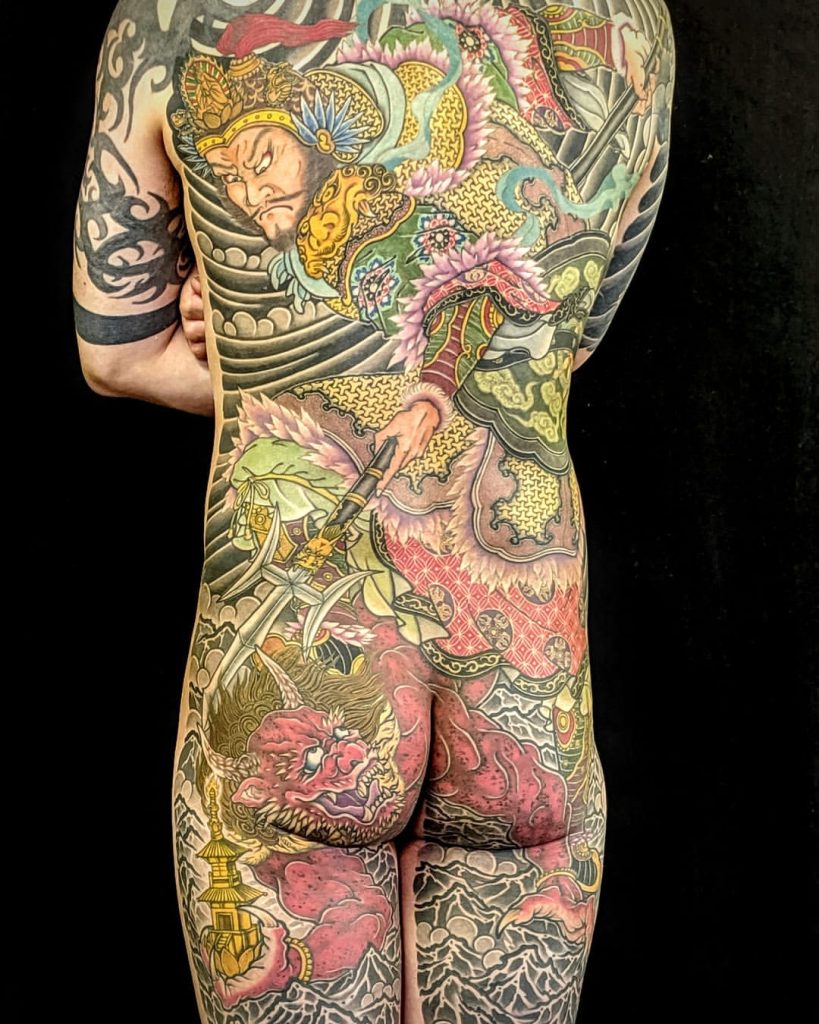
Bishamonten was a god of wealth and fortune in ancient Hinduism, and for that reason is also worshipped in Japan as a god of wealth and blessing. Also, because of the image of protecting Buddhism, there are shrines and temples where Bishamonten is enshrined as a god of victory in battle and a god who wards off plague and grants health.
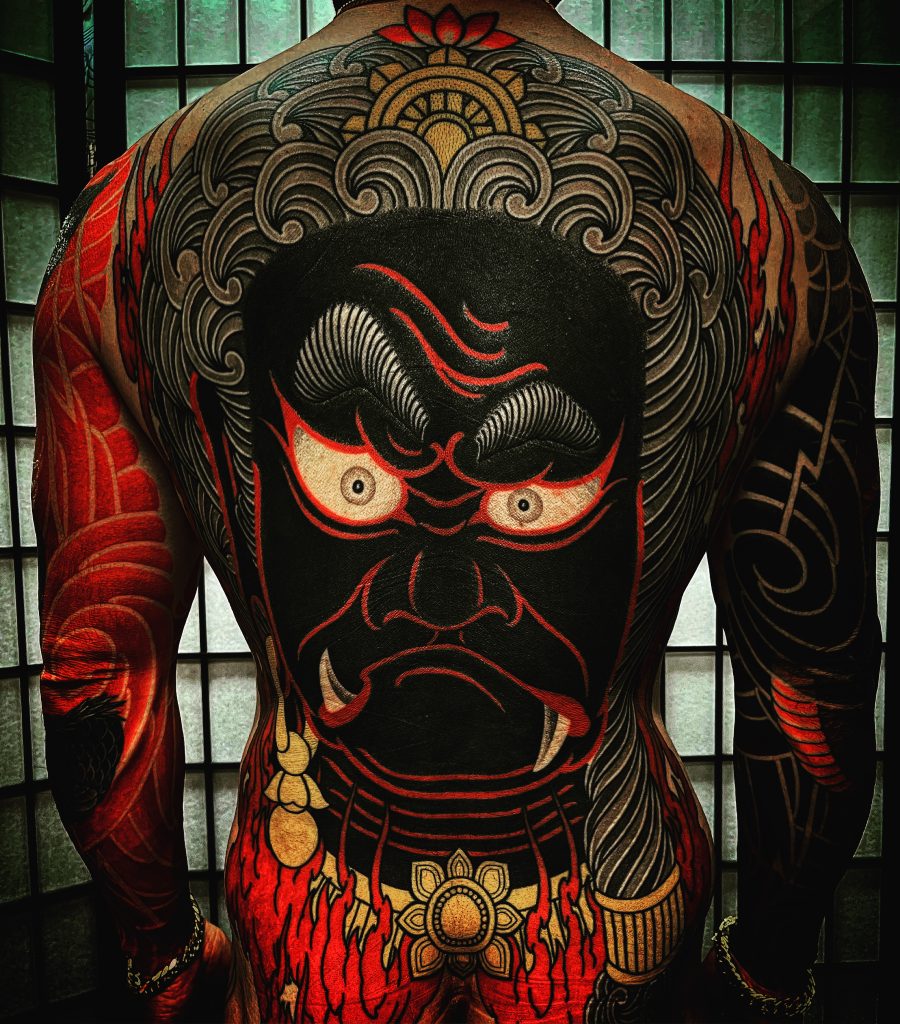
“Acala(Fudo Myoo)” is considered to be a manifested form of “Dainichi Nyorai”, the supreme Buddha of Shingon Esoteric Buddhism.
The “immovable” in Fudo means “the heart does not waver under any circumstances,” and it carries the meaning of admonishing the mind’s attachment to easy or pleasurable things—that is, worldly desires.
Also, Acala(Fudo Myoo), surrounded by flames, is known as a deity who burns away people’s worldly desires and demons, and therefore also carries meanings such as warding off evil and protection.
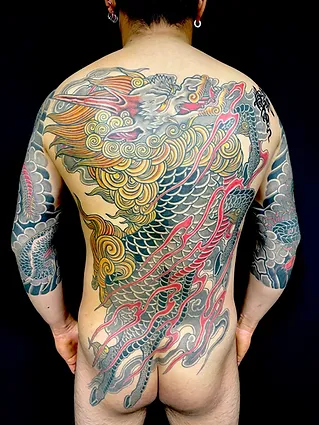
The kirin is a spiritual beast that appears in Chinese mythology. With a horse’s tail and horse’s hooves, and an extremely gentle nature, it runs through the sky without touching the ground so as not to harm anything. Such a kirin has long been regarded as a sign of good fortune, a being that brings stable and peaceful days, and a symbol of happiness.
For that reason, the kirin has meanings such as peace, affection, and wisdom.
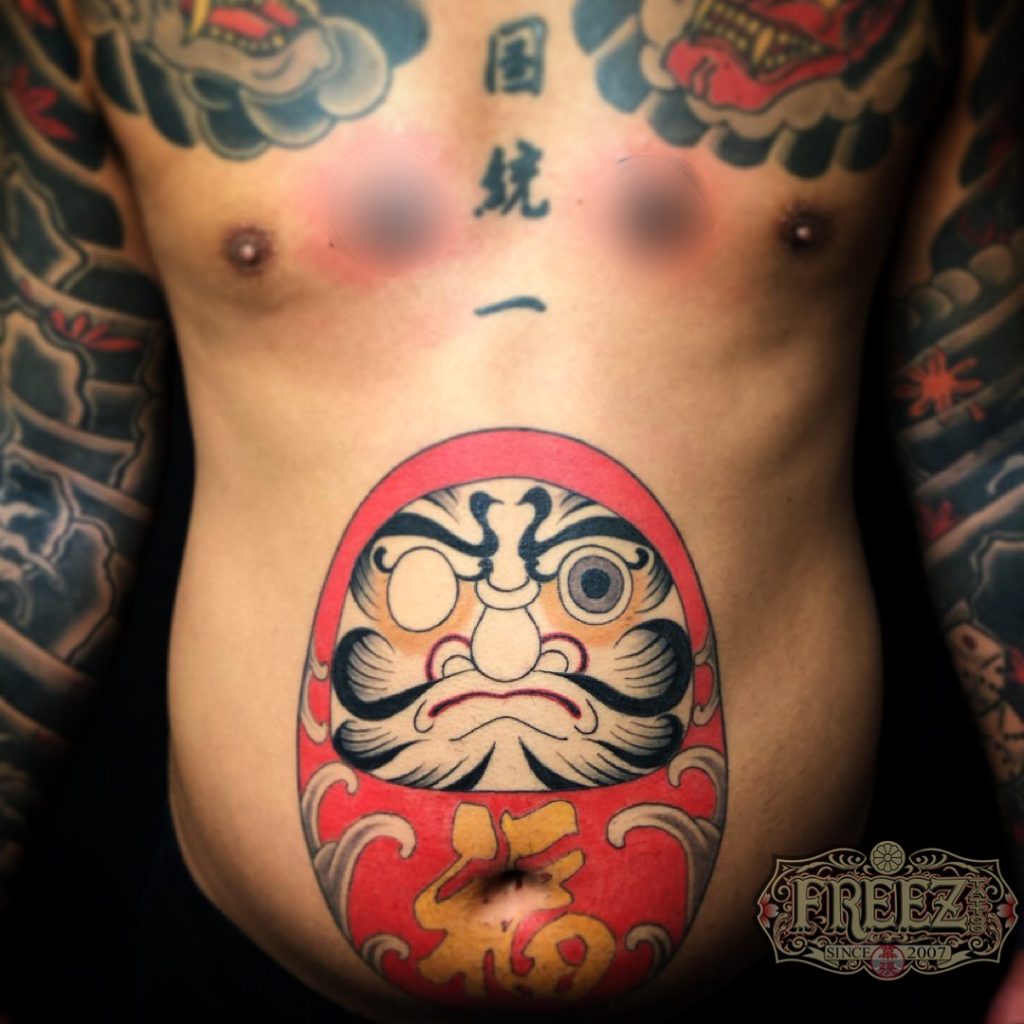
The daruma has long been familiar in Japan as a good-luck symbol for things such as passing entrance exams. Daruma tattoos are said to carry meanings such as perseverance, good fortune, and prosperity.
The meaning of perseverance has a certain legend behind it. Daruma is thought to be based on the monk Bodhidharma. According to one legend, Bodhidharma continued zazen facing a wall for nine years, and as a result his arms and legs rotted away; it is said that the daruma originated from this legend. That is likely why it came to include the meaning of perseverance.
The terminology of Japanese traditional tattooing differs from general tattoo industry terms, and some of the meanings can be hard to understand.
Below, we will introduce frequently used terms and their meanings.
A tattoo that is normally invisible but appears when body temperature rises—such as when entering a bath or becoming excited—is called oshiroi-bori. It does not exist in reality and belongs to fantasy, but in recent years there are tattoos that glow under black light, which are somewhat similar.
If you think of the arm length from shoulder to wrist, the elbow is at the middle point, so when tattooing extends from the chest or shoulder to around the elbow, it is called “gobu-sode”. This term is often used mainly in the case of Japanese-pattern work with background framing.
In English, this is called something like a half-sleeve tattoo. In clothing too, sleeves that reach around the elbow are called “half sleeves,” so it is a similar image. Depending on how far it goes, to around the elbow is “gobu-sode”, to around the wrist is “jubu-sode(full-sleeve)”, and slightly above the midpoint between elbow and wrist is called “shichibu-sode(3/4 sleeve)”.
In tattooing this would be called the outline, but the act of tattooing the lines of the stencil as a draft, or the lines themselves, is called “sujibori”.
This is a way of filling the inside of the outlined design, also called shading. It is a technique that creates depth by making gradients with different densities of ink.
That said, there are many kinds of bokashi as well, such as “Usu-bokashi(Smooth Shading)”, “Akebono-bokashi/Mizu-bokashi(Water Shading)”, and “Jari-bokashi(Stipple shading)”.
Tattooing only the main motif, without adding a background such as framing, is called “nuki-bori”. It is also called “danna-bori” or “uki-bori”. It is a technique favored even by people who do not like the heavy, intense feel of Japanese traditional tattooing.
Gakubori / keshobori refers to tattooing framing elements such as clouds, flames, waves, whirlpools, and rocks around the main motif using shading and gradation techniques with black ink.
By tattooing the background framing, it is possible to connect motifs between the chest and arm, or between the chest and abdomen, giving the whole piece unity while also making the main motif stand out. Basically, designs connected to the overall story are chosen.
Sometimes, oshiroi-bori and keshobori are mistakenly thought to be the same, but they are completely different.
When tattooing a human figure as the motif, tattooing the tattoos depicted on that figure as well is called “nijubori”. This is often done when the subject is a character from “Water Margin(14th-century Chinese novel)”, such as “Jiuwenglong Shijin” or “Senkaji Choko”.
Tattooing a completely different motif in places not usually seen by others, such as the armpit or inner thigh, is called kakushi-bori. Motifs tattooed as kakushi-bori include erotic images such as shunga, as well as names and words. In recent years, some people also tattoo anime characters there.
Tattoo work done using only black ink with shading is called karasu-bori.
The boundary between bare skin and the inked area, and the general area where the tattoo is cut off, is called “Mikiri”. Simply put, it is like the edge of the tattoo or the border with bare skin.
Mikiri is often confused with background framing, but adding framing around a nuki-bori design may be called “adding mikiri” or “putting in mikiri,” so it is sometimes used in place of the word for background framing.
Also, there are many types of mikiri, such as “Botan mikiri”, “Butu-giri”, “Akebono-mikiri”, “Jari-mikiri”, “Kumo-mikiri”, and “Juzu-mikiri”.
The rounded framing shape extending from the base of the arm across the chest is called “Hikae”. It is also sometimes called “Taiko”.
“Eguri” refers to the open space around the neck, or the curved shape, made so that the tattoo does not show from the neckline of clothing such as kimono.
Sarai means reworking lines or colors, and is also called a touch-up.
By doing sarai (touch-up), tattoo work whose color has faded or whose lines have blurred over time can be revived.
In this article, we explained Japanese traditional tattooing.
Passed down to the present day and now drawing attention from around the world, Japanese traditional tattooing can truly be called a traditional Japanese art form. Possessing a different charm from Western tattooing, Japanese traditional tattooing is now trying to evolve further as neo-Japanese tattooing. It is impossible to take your eyes off where it will go from here.